No Other Gods Before Me: Onomastic data and the emergence of monotheism in the southern Levant

The first and the sharpest of the Ten Commandments is “thou shalt have no other gods before me.”1
Israel’s insistent “whoring after other gods”2 is perhaps the most recurrent theme in the Old Testament. The prophets continually condemn their people for going “after other gods to serve them,”3 and they have Yahweh saying, “I am the first and I am the last; besides me there is no god.”4
Without getting into the thorny question of what is monotheism exactly, there is an interesting question of where this strident Yahweh-only ideology came from, even if it was not always honored by the greater part of Israel.
The Old Testament itself is clear enough: it came from Yahweh’s command on Mount Sinai. But stopping there wouldn’t be very interesting.
Israelite religion is often compared with the neighboring civilizations of Egypt, Mesopotamia, Greece, and Rome, all of which great powers subjugated Israel at one time or another, and whose own religious practice and tradition came into inevitable contact with those of the Israelites.
When compared with such nations, Israel’s religion appears fairly unique. Without denying certain strands of quasi-monotheism,5 the peoples and priests of those lands nevertheless saw little issue with the worship of “the whole host of Heaven.”6
So if all of the surrounding peoples were polytheists, from where did Israelite monotheism come from, if we aren’t satisfied with “Yahweh told them so?”
The best “control groups” for Israelite religion aren’t actually the great civilizations mentioned, but Israel’s immediate neighbors in the Levant during the formative period of the Late Bronze and Early Iron Age.
To the southeast there was Moab, to the northeast Ammon, and to the north Phoenicia.
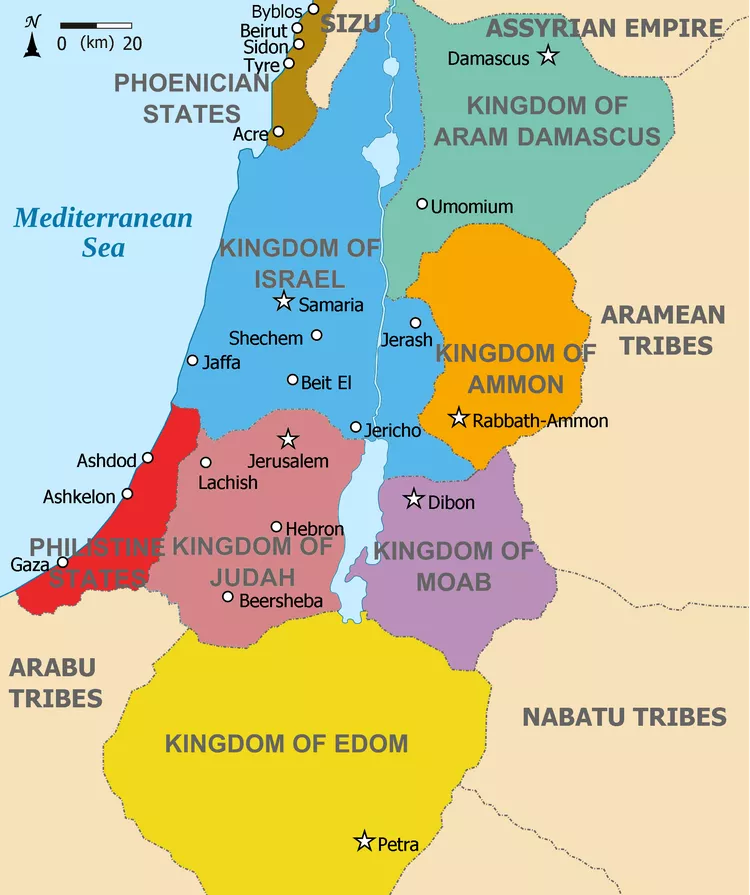
The reason Israelite religion7 is so often compared with Greece or Egypt rather than Moab or Ammon despite the latter two being far better comparisons in terms of common culture, language, and location, is simply because Hellenistic and Egyptian religion are much better recorded than the religion of any of the Levantine states of the period.
Israel itself is utterly unique for how much we know of her religion. There is no Moabite or Phoenician Bible. To an extent, this is a chicken or egg problem. Do we know so much about Israelite religion (and indeed, for many of us, practice a developed form of it) because Israelite scribes had the wherewithal to produce scriptures, or was there some third factor which explains both the survival of Israelite religion and the production of the scriptures?
In any case, even if we don’t have anything like the Torah or the Prophets for Israel’s immediate neighbor, that doesn’t mean we are flying totally blind. One potential point of light in the darkness is the corpus of personal names. These are mostly drawn from personal seals and amulets, which served decorative, votive, and political functions. Often inscribed with the wearers’ name, plenty have been excavated from the region over the decades.
I have briefly discussed Chemosh’s striking similarities to Yahweh elsewhere. Was he similarly jealous?
About fifty Moabite personal names have been recovered from inscriptions on personal seals. Of forty-eight Moabite PNs, a little more than half (25) contain a theophoric element; that is, they refer to some deity. Of these 25, thirteen are explicitly Chemosh names. Many of these will be very familiar to students of the Hebrew Bible, as they are exact equivalents to “Yahweh names” found in the scriptures as well as in the archaeological data. The name “Yehoshua,” the name of both the Old Testament hero Joshua and Jesus Christ, means “Yahweh Saves” or “Yahweh is Salvation.” Likewise, in Moabite inscriptions there is a name which translates to “Chemosh is Salvation.” The name “Jehoshaphat,” like the Judahite king in 2 Kings, means “Yahweh Judges.” Likewise, a Moabite name means “Chemosh judges.” The name “Azaziah,” found in 1 Chronicles 15:21 means “Yahweh is Strong/Mighty.” So is there a name in the Moabite corpus which means “Chemosh is Strong/Mighty.” Perhaps most tellingly is a name that simply means “Chemosh is El,” or “Chemosh is God,” a parallel to the Hebrew “Elijah,” and perhaps suggestive of a syncretization between Chemosh and the Canaanite high god El, similar to that between Yahweh and El.
Of the twelve theophoric names that are not explicitly Chemosh names, there are names containing the elements “El” and “Ba’al.” But while El could be the name of the Canaanite high god specifically, and “Ba’al” came to be a name specifically for the storm god Hadad, “El” is also simply the generic for “god” and “Ba’al” a generic for “lord,” both of which were often applied to deities other than the aforementioned two, including Yahweh. Only two names — one referring to the Canaanite/Ugaritic god Horon, one to the north Arabian goddess Rahban — explicitly and unambiguously refer to deities other than Chemosh.8
In their recent study, Family and Household Religion in Ancient Israel and the Levant, Rainier Albertz and Rüdiger Schmitt find that in Iron Age Israel, 67.6% of named persons in the onomastic corpus had Yahwistic personal names, with another 11.1% having El names, which plausibly refer to Yahweh. Another 1.0% had Ba’al names, which also plausibly refer to Yahweh. Only 7.3% had names which explicitly referred to deities other than Yahweh.9
The most monotheistic people in the southern Levant, judging solely by onomastic data were neither the Moabites nor the Israelites — they were the Ammonites. A full 81.8% of Ammonite names refer to “El,” with only 7.6% referencing other deities.10
The contrast to peoples in the northern Levant is stark. Rüdiger and Schmitt write,
Conflating the largely indistinguishable and undistinguished gods Baal and Hadad, both of whom largely shared the singular status of national god in their cultures, names alluding to this compound deity amount to 23.5% of known names and instances in Phoenicia, and 18.7% and 18.1%, respectively, of all names and instances in the Aramaic onomasticon. The inclusion of other weather-gods and related epithets in the group increases these percentages somewhat, to 24.3% and 24.0% in Phoenicia, and 21.5% and 21.4% in the Aramaic onomasticon. These “weather-gods” seem to have been unique to the Aramean and Phoenician family religions, because their names made up only a small percentage of the theophoric elements used in the Ammonite, Hebrew, and Moabite onomasticons (varying between 2.2% and 10.8%).11
The rest of the names referred to a wide variety of other Semitic, Egyptian, and Mesopotamian deities.
The picture seems relatively clear — in the southern Levant, by the early-middle Iron Age, pantheons were on the decline, and reverence for a singular national deity was on the upswing.
The evidence is sadly too fragmentary to make any confident judgments on why this shift took place, or why Israel’s religion survived and thrived, while those of her neighbors dissolved into the mists of history. Nor can we know if there were counterparts to the Israelite prophets in these lands, browbeating their people for failure to reverence Chemosh or El exclusively, but it’s tempting to imagine. Did some forgotten Moabite Elijah condemn Yahweh as “the abomination of Israel”?12
Exodus 20:3
Judges 2:17
Jeremiah 11:10
Isaiah 44:6
Neo-Assyrian propaganda often diminished the other gods to mere hypostases or appendages of Assur, Amun was occasionally elevated to such an extent that he was sometimes called “one and only God,” various Greco-Roman philosophers groped their way toward a philosophical notion of “the One” and so on.
Deuteronomy 4:19
Henceforth taken to refer to the religion of the whole Israelite people, even during the division of the kingdom into Judah and Israel
The foregoing almost all from “Did Chemosh Have a Consort (Or Any Friends)?” by Josey Snyder: https://www.academia.edu/3707430/Did_Kemosh_Have_a_Consort_or_Any_Other_Friends_Re_assessing_the_Moabite_Pantheon
Albertz, Rainer, and Rüdiger Schmitt. Family and Household Religion in Ancient Israel and the Levant. Penn State University Press, 2012. pp. 508
Albertz, Rainer, and Rüdiger Schmitt. Family and Household Religion in Ancient Israel and the Levant. Penn State University Press, 2012. pp. 510
Albertz, Rainer, and Rüdiger Schmitt. Family and Household Religion in Ancient Israel and the Levant. Penn State University Press, 2012. pp. 342
1 Kings 11:7, Chemosh is “the abomination of Moab.”
A good summary of the trends towards monotheism in the Levant; Judea was likely not alone nor pioneering in their theological compression.
Similarly, ancient Egypt in the New Kingdom held that all deities were part of Amun-Ra. An excerpt from the Leiden Hymns state "Every god is combined in your body, in your image." Elsewhere the Solar Litany of Seti I addresses Amun-Ra in various forms or actions and concludes each with "truly you are the body of <another god>". Even in Edfu Horus is said to "create the gods from his body" or "his mouth", and "the one who makes himself into millions" was another common solar creator high god epithet.
So we see in antiquity a general move to consolidate all deities in some sense, to acknowledge divine unity. Where polytheism differs from monotheism is that the former still recognizes the individual deities on their own as well, in order to also pay homage to the diversity and interplay of creation. When the gods retain their own personages, it is called "henotheism"; when the emphasis is on their collective identity among the highest god it is "monolatry". Hard monotheism doesn't even acknowledge the subordinate gods, or else demotes them to lesser beings unworthy of worship (see: angels).
Henotheism and monolatry seem more compatible with pluralistic societies since other deities can be rolled into their schema. What's one more, after all? Monotheism tends to be intolerant of other religions, especially if it has an expansionist bent, such as Christianity or Islam. Judaism as least polices itself in house and waits for the messiah to prove them right to the "nations".
In relation to the same issue of similar Gods in the region, something I’ve been thinking about the last few days is that part of the way God reveals himself is by showing his power, i.e., it becomes “see? Our god is more powerful than your god, therefore he is the God”. But if every (or at least multiple) nation(s) had their own God or gods, then one of them will win, and that will serve as proof that they have the “real” God or pantheon. But even without God, one of them would be likely to be the dominant power in a region. In other words, if everyone sits down to play cards, and everyone says their God is on their side, then someone will win the game, and that will serve as proof that their God is the right one. But obviously, this is just chance, not divine providence. And yet, when it comes to religion, that probabilistic outcome is framed as divine providence on the basis of circular reasoning: we know God’s providence makes his nation the most powerful because we know he exists on account of that power.